The Universal Social Planning Bus
Group chats are the operating system of our social lives.
They're where trips get suggested, birthdays get planned, restaurants get debated, screenshots get dropped, flights get forwarded, expenses get forgotten, and someone eventually asks: "so what's the plan?"
For a while, this worked well enough.
Email chains helped people coordinate. Facebook Events made parties announceable. WhatsApp, iMessage, and Instagram made it effortless to talk to anyone, anytime. Then Maps, travel guides, booking sites, notes apps, spreadsheets, Splitwise, calendars, and short-video platforms all became part of the planning stack.
The result is strange. We have more tools than ever, but making a simple plan feels harder than it should.
A weekend trip to Goa starts from an Instagram reel, moves to WhatsApp, becomes a Google Sheet, gets buried in Maps saves, disappears into an Airbnb link, and ends with one person manually working out who owes whom.
A Friday night plan involves ten messages, three restaurant links, two people saying "anything works," and no actual decision.
This is supposed to be social life. Technology should make it easier to see the people we love — not turn every hangout into project management.
We think social planning needs a new layer. We call it the Universal Social Planning Bus.
The Planning Tax
Today, a single plan can involve:
- WhatsApp or iMessage for discussion
- Instagram, YouTube, or TikTok for inspiration
- Google Maps for places
- Google Calendar for time
- Notes or Sheets for the itinerary
- Splitwise or UPI for expenses
- Airbnb, hotel & flight links for logistics
- Screenshots for everything else
Each tool is useful. None of them own the plan.
The restaurant is in one app. The dates are in another. The itinerary is in a spreadsheet two people will never open. The split is in someone's head. The address is buried in a Tuesday chat.
The real plan isn't in any one place. It's scattered across everyone's phones.
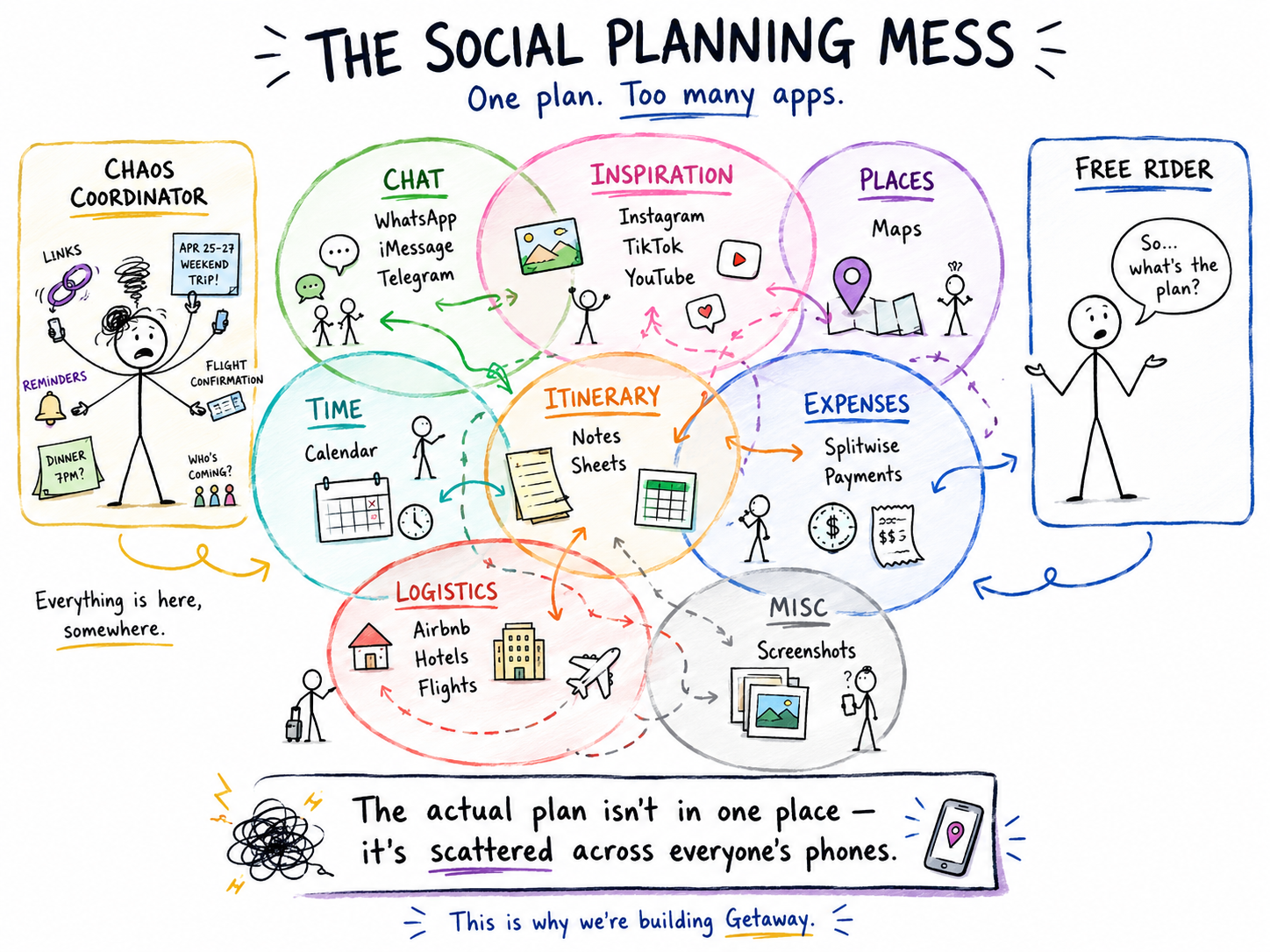
This is a tax — paid in friction, in dropped plans, in the slow drift of friendships that should have been seeing each other every other weekend but ended up seeing each other twice a year.
The Chaos Coordinator and the Free Rider
In every group, two roles emerge.
The Chaos Coordinator builds the spreadsheet. They pin messages, chase confirmations, track bookings, split expenses, and re-explain the plan three times. They love their friends. They're also burning out.
The Free Rider mutes the chat, reacts with emojis, and messages the coordinator the day-of: "wait, what time are we meeting?"
They're not bad friends. They're busy. Most products quietly assume the Chaos Coordinator will keep doing the work. We think the software should do more of it.
What we lose
We are spending more time on our phones than at any point in human history, and we have never felt more alone.
The infinite scroll won. TikTok, Instagram, YouTube — they're extraordinarily good at showing us places we could go, food we could try, experiences we could have. They mostly stop at inspiration.
Real life has trouble competing, partly because real life requires planning, and planning is broken.
Our parents' generation saw their college friends once a quarter without effort. Ours sees them once a year if we're lucky. The friendships are still there. The infrastructure isn't.
We don't think the answer is more screen time. The answer is for the planning itself to disappear — so the showing up can happen.
Enter Getaway
We started building Getaway because we wanted planning to feel less like coordination work and more like the beginning of the experience itself.
The idea is simple: every plan should have a home.
Not a buried chat thread. Not a spreadsheet. Not a folder of screenshots. A living space where people, places, decisions, schedules, money, and next steps all stay connected.
Everything that used to live in five apps now lives in one:
- Trip itineraries — day-by-day, with maps, distances, and routes optimized automatically
- Top spots — pulled from blogs, guides, reviews, and reels across the web. Tap to add
- Road trips — start, end, stops, dhabas, and fuel split with the crew
- Shared calendars — see when your whole group is free without sending fourteen "when r u free?" messages
- Hangout pages — every event gets its own page: photos, RSVPs, location, group chat, dress code, who's bringing what
- Expenses — automatic splits, INR-native, no awkward "bhai tu ne kitne diye the?"
- 10+ built-in games — Mafia, Who Am I, Truth or Dare, Werewolf — for when you're already together and want to stay off your phones
- Memories — your trip photos auto-collected into a shared album when it's over
Getaway isn't meant to be another silo. It's the connective layer between inspiration and action.
What the Bus makes possible
Discovery becomes actionable
Today, people discover places everywhere — reels, shorts, travel blogs, screenshots — and most of it dies as a saved post no one revisits.
In Getaway, a reel, a city page, a top attraction, or a bookable experience isn't just content. It's something you can add to a trip, propose to friends, or turn into a plan in two taps.
Group coordination gets lighter
Most groups don't fail because people don't care. They fail because decisions are spread across too many messages.
Getaway makes the next step obvious. Who's coming. What's decided. What's still open. The plan moves forward without anyone having to herd it.
Trips and hangouts share one foundation
A coffee plan and a five-day trip differ in complexity but share the same core objects: people, places, time, decisions, communication, follow-through.
Event tools are too light for trips. Travel tools are too heavy for a Friday night. Calendars know the time but not the vibe. Getaway is built around what they have in common.
The coordinator stops carrying the group
Your friends may not become organized. But the plan can be.
The AI agent that plans for you
The next leap is bigger than anything we've built so far.
We're building a voice-first AI planning agent inside Getaway. Not a chatbot. Not a novelty. An agent that understands your friend group, your city, your saved places, your past trips, your budget, and the kind of experiences you actually enjoy.
Imagine opening Getaway on a Wednesday evening. You say one line:
"Plan something for me, Sam, and John this Saturday."
The agent gets to work. It checks the shared calendar — Sam is free after 6 PM, John is in town. It pulls from places the three of you have liked before, considers the weather and the budget you usually keep, picks the best fit, drafts the invite, books the table, and hands the whole thing to you ready to send.
Total time from thought to plan: fifteen seconds.
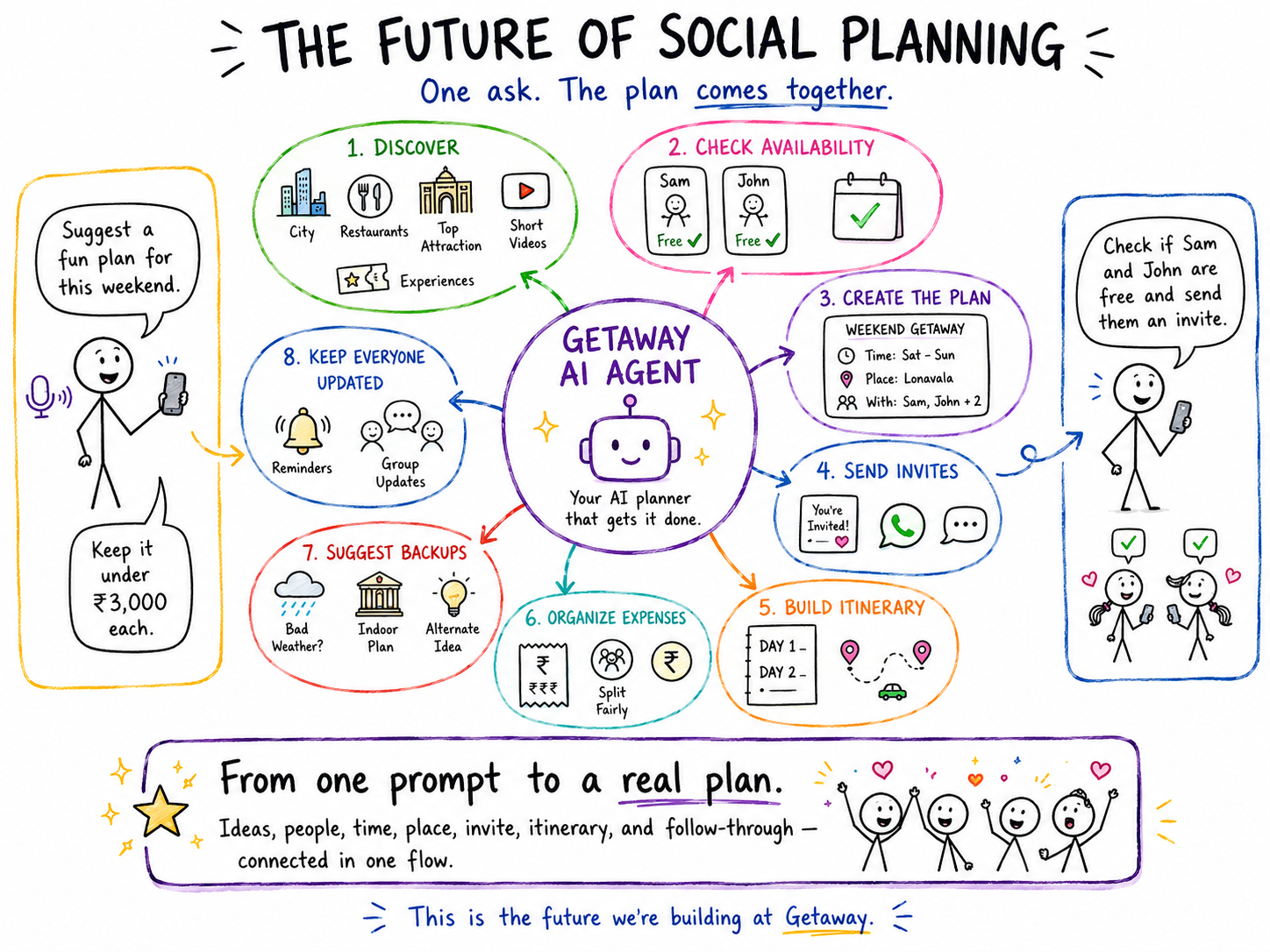
It keeps going. It learns Sam doesn't drink and suggests a café instead of a bar. It notices John is moving to Bangalore next month and quietly nudges you to plan something before he leaves. It spots that you and your college friends haven't been in the same room in eleven months and suggests a weekend that works for all six.
You'll talk to Getaway the way you'd talk to the most organized friend in the group:
"Plan something fun this weekend with Sam and John. Keep it under ₹3,000 each, avoid long travel, send them an invite."
This isn't a feature. It's the thesis. Planning is the friction. Friction is what kills friendships. Remove the friction and you change how often the people you love see each other.
That changes everything.
Our north star
Every important company has a single sentence that explains why it exists.
SpaceX is building rockets to make humanity multi-planetary.
Anthropic is building AI that's safe and beneficial for all.
Google set out to organize the world's information.
Ours is smaller in cosmic scale, but deeply human:
"Make real-world togetherness effortless."
We want Getaway to become the AI operating layer for social life — the system that helps people move from "we should" to "we are."
That's the world we're building toward. Where keeping the people you love close to you takes no effort at all. Where the lonely weekend is a thing of the past. Where the question is never "when did we last see each other?" because the answer is always "last weekend."
Everything we've shipped so far is a step in that direction. The itineraries, the calendars, the games, the splits, the voice agent — they're all infrastructure. The destination is a world where the friendships of your twenties still feel close in your forties, because the system actually helps you show up.
We're not there yet. We will be.
Why this matters
It's easy to underestimate planning because it feels mundane. But planning is the bridge between wanting a better life and actually living one.
You can want to see your old school friends more often.
You can want to spend more time with family.
You can want to explore your own city.
You can want to travel with your partner.
You can want to finally take that trip everyone has talked about for years.
But unless someone turns that desire into a plan, it remains a thought.
Our mission is to make real-world social connection effortless. We want:
- More dinners that actually happen
- More weekend trips that leave the group chat
- More birthdays where nobody is confused
- More city days
- More spontaneous hangouts
- More road trips, more reunions, more date nights, more family outings
We want technology to help people spend less time coordinating and more time together.
Let's get the getaway started.
Real friendships don't die from lack of affection. They die from logistics.
We're here to take the logistics off your plate so the friendships can do what they're supposed to.
If you've ever been the chaos coordinator — this is for
you.
If you've ever been the free rider — this is also for you.
The best memories usually begin with someone saying:
"Let's go."
Our job is to make sure that's enough.
— The Getaway team
MAde with 💖 for
you!.